
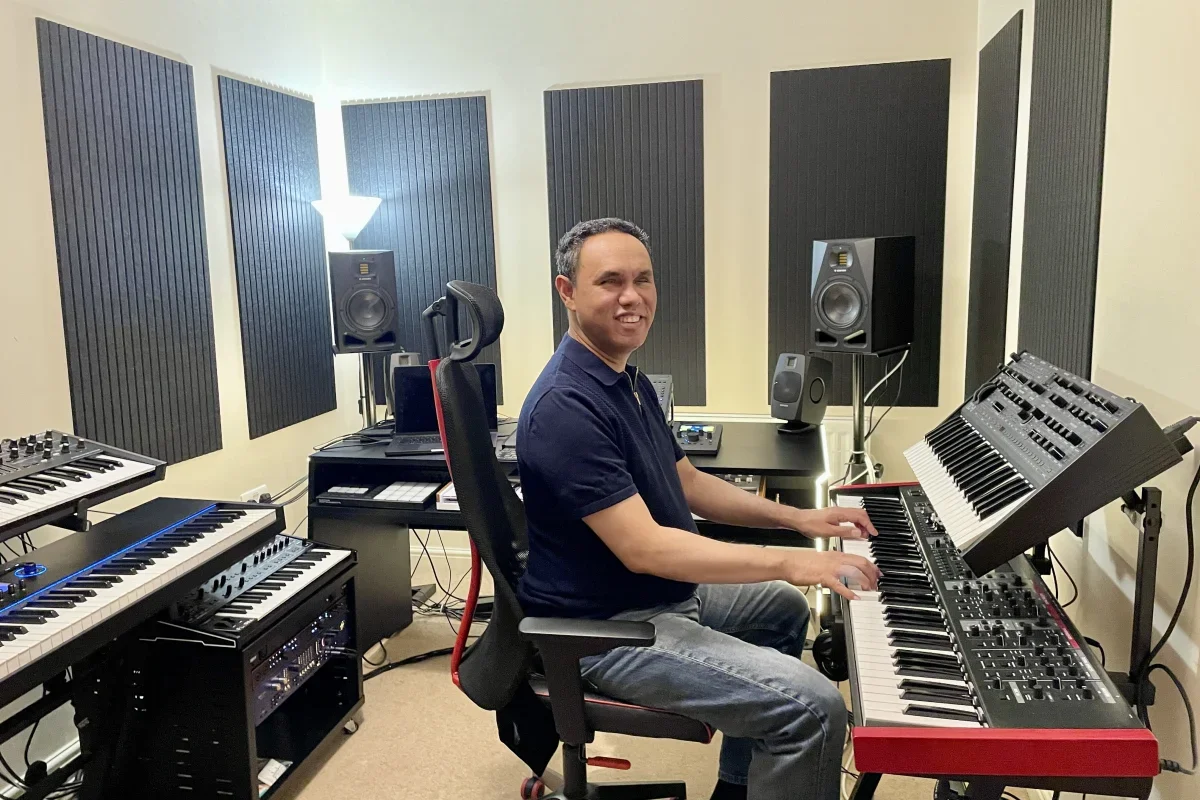
Roland Future Design Lab put the V-STAGE Accessibility Guide online on August 6, built with Jason Dasent, a blind Trinidadian musician, producer and accessibility consultant based in the UK. The keyboard was his pick, not Roland's. "The V-STAGE was his idea," says Paul McCabe, SVP of Research and Innovation at the lab. "He recognized that an instrument built almost entirely around physical controls could become one of the most accessible keyboards available."
Dasent's target was the documentation. "Owner's manuals ... are fundamentally built around diagrams. And diagrams have almost no value to a blind person," he told Roland's Articles site on August 5. "A set of traced lines on a page doesn't tell you what you're touching or why it matters."
So the guide describes the instrument the way hands meet it. "I describe every control, every button, every connection, in the order your hands will actually find them," Dasent says. Chapter 1 is the rear panel, before anything makes a sound. Then organ, acoustic piano, center section, electric piano, synthesizer, total effects, master section: eight chapters plus a Best Practices section, each one published as screen-reader-friendly text in HTML, Word and PDF, as an MP3 walkthrough, and as video with audio description. You can pull the whole set down as a ZIP.
Our own Your First DJ Setup is text the whole way down, no diagrams in it, and it still sorts gear by category rather than by where a hand lands on the panel.
2009: "accessible" meant auto beat match
That word has been in our gear archive for years, attached to price and learning curve. In January 2009 we ran Tonium's press release for the new Pacemaker under the headline "Makes DJing Accessible to Everyone." The accessibility on offer was auto beat match and a claim that anyone could learn to mix "in less than 2 minutes"; Ola Sars, then Tonium's VP of sales and marketing, said the goal was "to remove all barriers and let anyone interact and experiment with their music." Ten years on we ran Roland's own GO:PIANO88 announcement, which opened "Start Learning Piano Today" and sold 88 full-size keys, Bluetooth and a low price. Nothing wrong with either one. Neither was about playing without sight.
The V-STAGE can be described that way because of a hardware decision: its physical controls map close to one-to-one onto parameters, so a panel you have learned by touch stays learned. "The V-STAGE already speaks the language blind musicians need: tactile, consistent, and built for muscle memory," Dasent says.
Roland calls this a proof of concept, and the limits are real. One keyboard, and a survey form on the guide page collecting notes from visually impaired players before the lab makes its case for doing this across the catalogue. No V-STAGE has been through our hands, so nothing here is a judgment on the instrument.
Dasent puts the goal further out than one keyboard. "I want accessibility to just be the norm."