
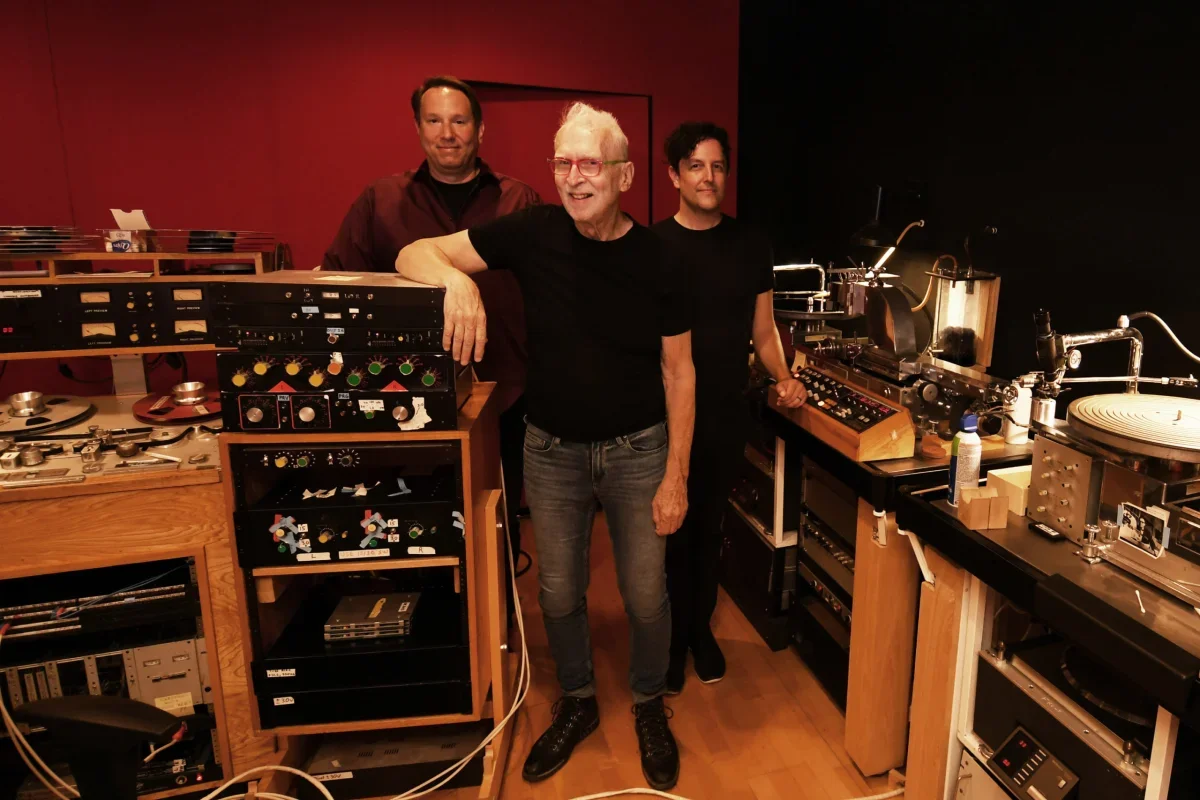
Patrick Gleeson died on July 19 at 91. The Bob Moog Foundation announced it on behalf of his estate, and no cause of death has been disclosed.
He came to the instrument late and sideways. Through the 1960s he was teaching 18th-century English literature at San Francisco State. In 1968 he co-founded Different Fur recording studio with his studio partner John Vieira, and the two of them ran it until 1985.
Hancock worked there on Crossings (1972) and Sextant (1973). Headhunters was cut in the same room. Hancock later credited Gleeson with introducing him to synthesizers, which runs the opposite direction from how these credits usually read: the famous name is the one being shown something.
The job had a title
The machines were a Buchla Box, a Moog III modular, an ARP 2600 and an E-mu polyphonic. Naming them matters, because records from this era get filed under the composer and the instrument while the person patching the thing goes uncredited in both directions.
Gleeson did not go uncredited on Apocalypse Now. Francis Coppola's film lists him as Master Synthesist, which is a strange job title and an accurate one. Somebody had to actually know what the machines did.
He made his own records alongside the session work. Beyond the Sun, his 1976 electronic portrait of Holst's The Planets, got him a notice from Wendy Carlos that reads like a colleague exhaling:
Our eight-year wait for someone else to explore electronic music realisation with what we judge to be appropriate technical standards and musical taste has ended.
Carlos went further in the same passage, describing "the ears of a gifted musician at work, in a field where one must exercise unprecedented discipline and self-control." Eight years of waiting, by her count, ended by a man who had opened Different Fur the same year the count started.
What does not go in a box
Devo, Brian Eno and David Byrne all came through his orbit, as did Kronos Quartet, Pat Metheny, Bennie Maupin, Freddie Hubbard and Joe Henderson. He was still releasing music in his eighties, including Fourever in 2021.
Earlier this month we covered the 4,489 items inMusic donated to the Bob Moog Foundation archive, the schematics and bench prototypes and handwritten engineering notes. Gleeson's kind of work is harder to archive than a prototype. It sits in other people's discographies, in a room in San Francisco that closed in 1985, and in a film credit that had to invent a name for what he was doing.